
Introduction
SIGDOC is committed to working toward a culture of accessibility, and we hope this conference will be a step forward in developing deeper commitments to accessibility in our field. Accessibility is a group effort. As you prepare for and participate during this year’s conference, we encourage you to consult the resources in this document to help SIGDOC continue its goals of greater inclusivity.
The goal of SIGDOC is to make every conference accessible for as many people as possible – both delegates and speakers – without them having to disclose their accessibility needs, so that they can attend without asking for treatment as a special case. However, funding constraints, location considerations, catering contracts can sometimes impact the ability to do so. So we request you to contact us if your question is not answered here or if the conference arrangements as described are not enough to allow you to attend. We will work with you, to the best of our ability, to make the conference more accessible and meaningful.
This document is a constant work-in-progress as we reflect and learn from our experiences at each conference. Every conference poses new challenges, but the SIGDOC community is committed to addressing as many as possible with each iteration. We acknowledge the work of several community members in developing this document starting with Sherena Huntsman, the accessibility chair of SIGDOC 2023, who developed most of the materials. Before Sherena, Emma Rose developed a FAQ section for participants attending the SIGDOC 2019 conference. The pandemic put a hold on these efforts, but they were soon revitalized as SIGDOC became an in-person event again. The SIGDOC 2024 chairs, Nupoor Ranade and McKinley Green, used previous knowledge and resources while adding new content to publish the document in the current format.
As organizers, we faced a series of challenging decisions related to the format of this year’s SIGDOC. While in-person conferences can present barriers to participation, virtual conferences can be significantly different and require completely different assets and tools. Because of the resources available to us, it was difficult to run both – the in-person events and provide virtual support. Accordingly, while SIGDOC 2025 is primarily an in-person conference, there are virtual presentation options available for presenters if it’s for personal health, accessibility, or emergency reasons. Please reach out to us with questions.
Preparing to attend SIGDOC 24
Registration
Typically, the registration is done through Cvent. You’ll find the registration links on the conference webpage, when they are available to share. When you go through the registration process, there will be spaces to communicate most accessibility needs. The organizers refer to the early registrations when making most planning decisions. While SIGDOC cannot guarantee all accommodations, we will work with you to address any requests you have in the best way we can.
Communicate accessibility needs: Please respond to the registration question labeled “Do you have a disability or special need that impacts your access to ACM conferences, special interest groups, publications, or digital resources?” in as much detail as possible. In your response, please indicate any accessibility needs such as wheelchair access, sign language interpretation, or a guide. The Conference Chair/Accessibility Chair will follow up with you to clarify your needs.
Printed copy of program:The SIGDOC conference program will be made available on the website for easy access and sustainability. If you need a print copy of the program (with or without any specific formatting requirements), please let the conference chairs know in advance.
Communicate food requirements:Careful thought has been given when deciding the menu of this conference especially in terms of cultural norms, allergies and general preferences. Please convey other requirements through your registration so that the organizers can prepare for it.
Food at SIGDOC: Dinner is included on Thursday (CPTSC – dinner buffet). More detailed food information at SIGDOC is listed on the Attending SIGDOC page.
Preparing posters
Posters should be no larger than 36” tall x 48” wide (0.9 m x 1.3 m). We plan to place posters on easel stands with cardboard backing. Therefore, either paper or fabric posters are acceptable.
Poster Accessibility:We encourage the following best practices for accessibility of poster presentations. We also suggest including a url or QR code linking to an accessible, downloadable version of your poster.
Clarity:Use plain language, spell out acronyms and abbreviations, define terms, and avoid or define jargon. Provide information in multiple formats, such as by combining text, images, graphs, and tables. Keep text concise.
Format: Use large, bold, sans serif typefaces, such as Arial, Geneva, Helvetica, Roboto, or Open Sans, on plain backgrounds. Use 72–152 point font for the title; 48–56 point for section headings; and 24–36 point for body text. Provide adequate spacing, avoid clutter, and visually highlight sections with borders, headings with color, and spacing.
Visuals: Use color combinations that are high contrast can be distinguished by those who have color vision deficiency. Keep graphics and tables simple. Provide captions for tables and graphics. Avoid blurry images by including those with at least 300 dpi resolution.
Organization:Readers should be logically led in the correct direction from the title through the poster by a clear narrative and logical design. In your verbal presentation, describe the major points in the poster concisely for your audience.
Preparing slides
We recommend that presenters giving talks use slideshare software, such as PowerPoint or Google Slides, to record visual presentation components. We anticipate allocating 12 minutes for each oral presentation; members of organized panels should expect 12 minutes per person. A recommended practice for timekeeping is to bring a timer (e.g., on a smartphone) with you to help you keep your presentation on time. To minimize disruptions and lost time caused by switching between laptops and connecting to WiFi, we will ask that:
- each session’s presenters coordinate before the start of their sessions and put all talks onto a single laptop;
- presenters who use cloud-based storage download their talks to avoid any unanticipated internet-related slowdown.
We will try our best to provide session moderators to assist with timekeeping and coordination. Use best practices for all document formats that you plan to use at the conference.
- Google Slides Accessibility: tinyurl.com/muya2vwp
- Keynote Document Accessibility: tinyurl.com/46k9eyef
- Microsoft PowerPoint Accessibility: tinyurl.com/wa7kkjb4
- PDF Accessibility: tinyurl.com/yc7fvfsx
- Working with Interpreters: tinyurl.com/2p8sv4y5
Venue and Location
Getting to the Conference Location
Refer to the travels arrangement page, Attending SIGDOC, for information on getting to the city and campus by flights, trains, or driving.
Meeting Rooms
All events will take place on the first and second floors of the Student Union Building (SUB). Refer to the maps and details about the rooms below.

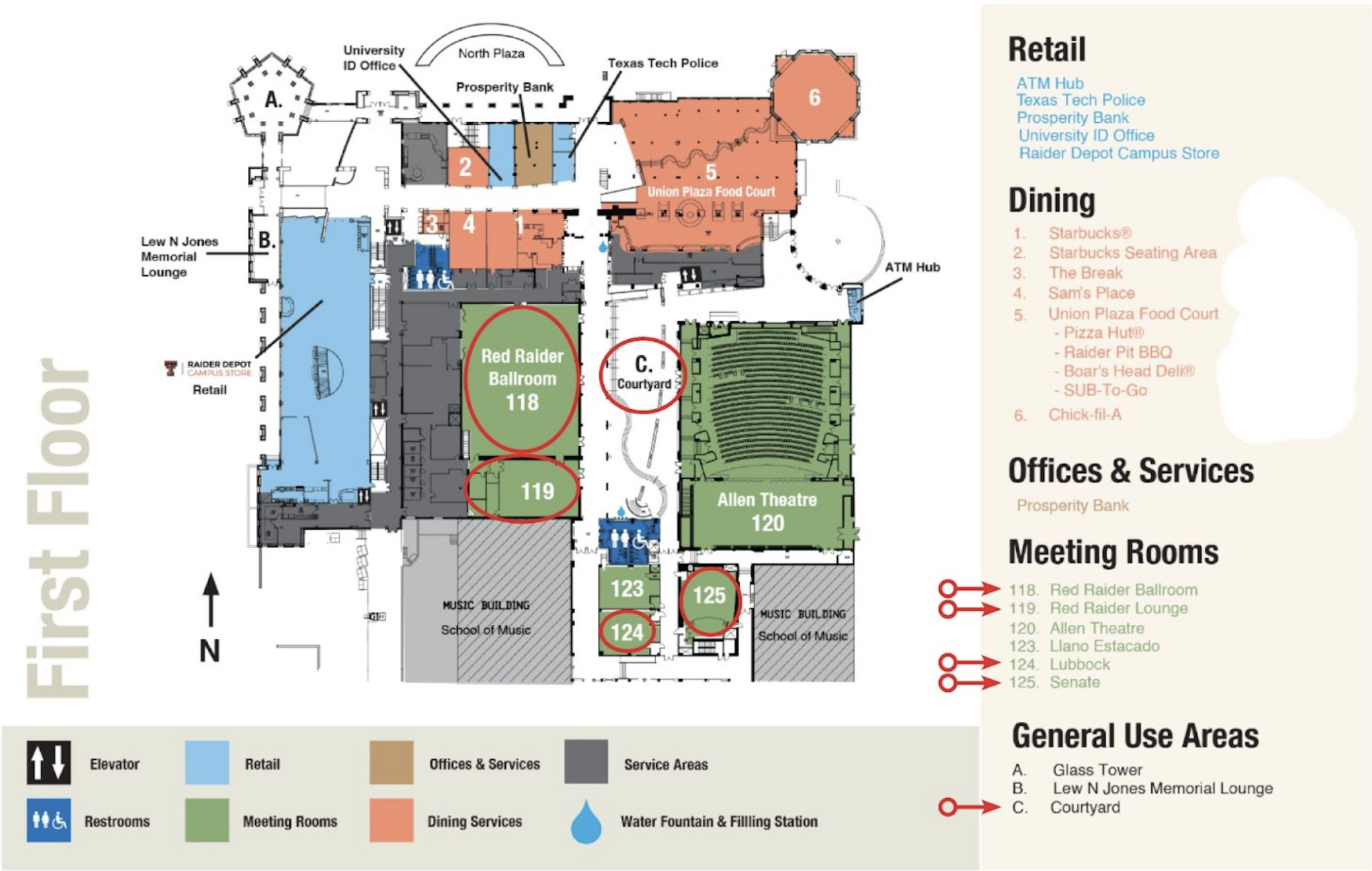
- TTU SUB Building website
- Stairs and elevators: The SUB main entrances have some stairs but also accessible ramps. Elevators are available in the building. There is an information desk on the first floor (in addition to our conference registration station in the SUB Courtyard) if you need directions.
- Capacity: Each meeting room can fit 45–60 persons, with greater capacity in the ballroom. There will be space to stand or pull up wheelchairs and scooters. There will also be ample space to bring your service animal, crutches, or any other equipment you need.
- Seating and capacity arrangement: Use this link to visit the Texas Tech University Student Union Building website to view photos/layouts of the rooms where panel sessions will be conducted:
- SUB Lubbock (Room 124)
- SUB Senate (Room 125)
- SUB Playa (Room 213)
- SUB Mesa (Room 217)
- SUB Canyon (Room 218)
- SUB Traditions (Room 233)
- Red Raider Ballroom (Room 118)
- Red Raider Lounge (Room 119)
- Technology instructions: All meeting rooms will have a central console to control the AV system. Touching the panel screen will start the system and the display screen(s) will automatically power on. The PC will be the default selection. You can tap to select the appropriate source button for viewing (“laptop” if connected through HDMI). The ballroom AV setup should be similar. Wi-Fi/internet connection information can be found in the program.
ASL Interpretation and Auto-Captioning
The conference will provide a team of sign language interpreters or captioners if requested by any attendees during the early registration period. Please make your request as early as possible. The SIGDOC Access Chair will follow up with you to discuss your needs in more detail. After the early registration deadline, a best effort will be made to accommodate requests, but we cannot guarantee that interpreters or captioners will be available.
Restrooms
There are restrooms on the first and second floors of the Student Union Building (refer to maps below). There are no gender-neutral restrooms in the building. If you have concerns, please reach out to the Conference Chair.
Lactation Space
A designated lactation (labeled mother-friendly) room is available on the second floor of the Student Union Building (refer to the second map below), which is open in accordance with building hours. Please lock the door when you are using the space.
Quiet Space
At SIGDOC 2025, we will provide a quiet room during the conference. You can use the room for prayer, quiet time or any other needs. Please contact the Conference Chair for details.
Additional Accessibility Needs
Face Coverings
Face coverings will not be required for conference attendees for SIGDOC 2025. We encourage everyone to consider their own well-being and the well-being of everyone else at the conference through vaccinations and using face coverings when required. The nature of conference attendance brings together people from different locations and with different experiences and needs. To mitigate the risks associated with bringing people together in close quarters, we recommend that attendees take all the measures that are needed.
Service Animals
Guide dogs and other service animals are welcome at SIGDOC. There will be a relief area with water available. All of the conference venues welcome service animals. Please indicate on your registration form if you anticipate bringing a service animal to the conference.
Medical Needs
The nearest hospital to campus is the University Medical Center at 602 Indiana Avenue, Lubbock, TX 79415, which is approximately 2.5 miles and 9-minute drive away. The nearest pharmacy is Walmart Pharmacy, at 1911 Marsha Sharp Fwy, Lubbock, TX 79415, which is approximately 1.6 miles and a 7-minute drive away. For medical emergencies in the United States, please dial 911. For non-emergency needs, contact the Conference Chair.
Organizer Contacts
If you require any other care such as medical, accommodation or other services, please contact the Conference Chair Jason Tham at jason.tham@ttu.edu or +1 (320) 310-9654.